


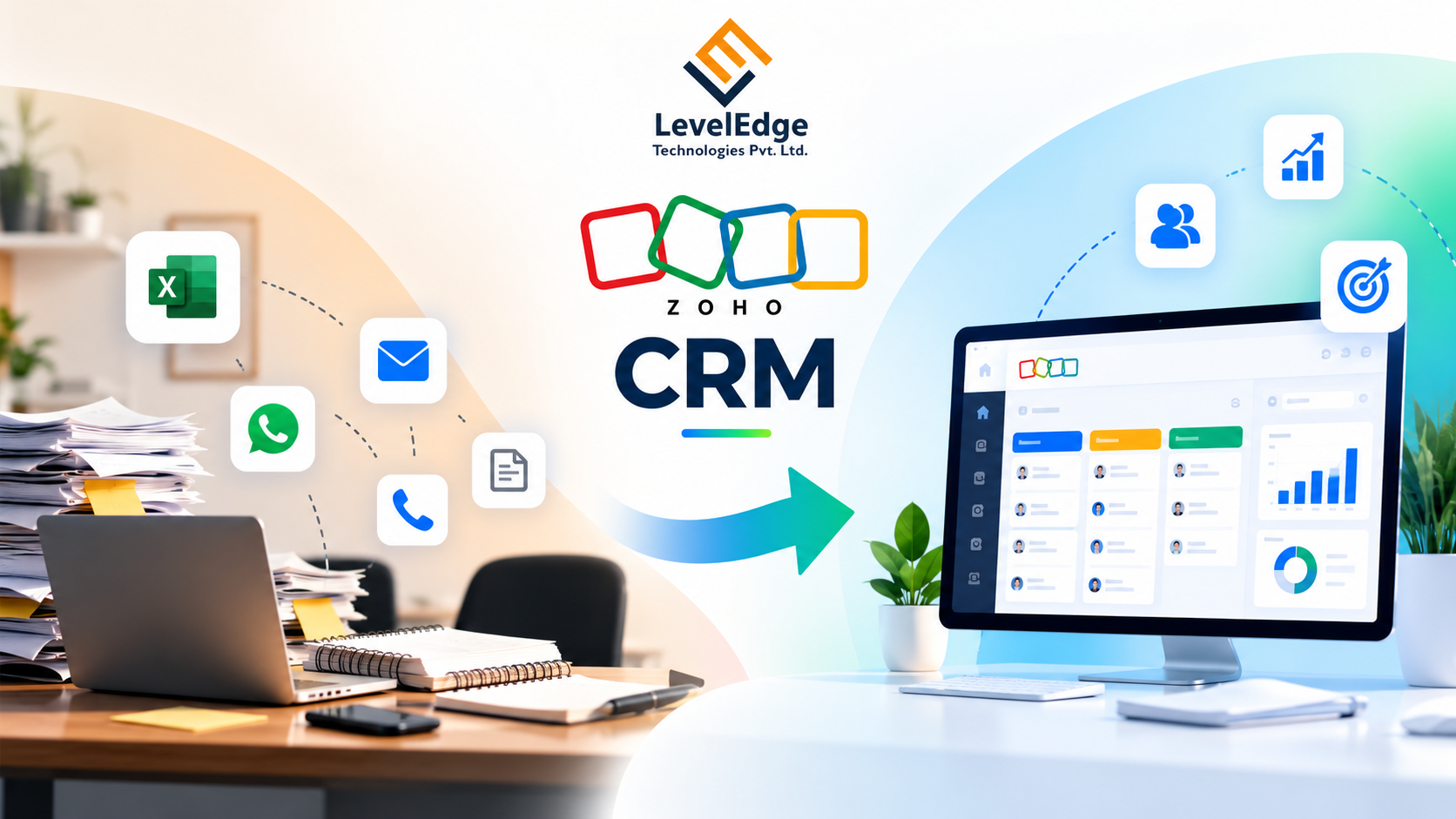
As businesses grow, managing leads, tracking sales opportunities, and maintaining customer relationships become increasingly complex. What works initially with Excel spreadsheets, emails, and WhatsApp conversations may eventually lead to missed follow-ups, scattered customer data, and limited visibility into sales performance.
For growing businesses, the question is no longer just how to manage sales activities, but how to build a consistent, scalable sales process.
This is where Zoho CRM can make a difference. By centralizing customer information, automating repetitive tasks, and improving sales reporting, it helps businesses move beyond manual sales management.
In this article, we compare Zoho CRM with traditional sales management methods, explore the benefits of CRM adoption, and explain how working with an experienced Zoho partner can help businesses get more value from their investment.
What Is Traditional Sales Management?
Traditional sales management involves tracking leads, customers, follow-ups, and sales performance through spreadsheets, emails, phone calls, and messaging applications.
While this approach may work for a small team, it becomes difficult to maintain as customer volumes and sales operations expand.
Common challenges include:
- Missed follow-ups and delayed responses to prospects.
- Customer information scattered across multiple files.
- Difficulty tracking deals and sales representatives’ activities.
- Time-consuming manual reporting.
- Inconsistent lead assignment and qualification.
- Limited visibility into sales performance and future revenue.
These challenges can slow down sales operations and make it harder for management to identify opportunities for improvement.
What Is Zoho CRM?
Zoho CRM is a customer relationship management platform that helps businesses manage leads, contacts, accounts, deals, and customer interactions in one place.
It enables organizations to structure their sales pipelines, automate follow-up activities, generate reports, and customize workflows according to their business requirements.
For companies looking to improve sales efficiency, Zoho CRM provides a centralized environment where teams can track opportunities, maintain customer records, and make informed decisions using sales data.
However, the software alone does not guarantee better results. The right configuration, clean data, appropriate automation, and consistent user adoption are equally important.
Zoho CRM vs Traditional Sales Management
| Business function | Traditional sales management | Zoho CRM |
|---|---|---|
| Lead management | Manual spreadsheets | Centralized lead records |
| Follow-ups | Personal reminders | Tasks, reminders, and automation |
| Deal tracking | Manually updated sheets | Structured sales pipeline |
| Customer history | Information across multiple tools | Consolidated customer records |
| Reporting | Manual calculations | Configurable dashboards and reports |
| Team coordination | Frequent manual updates | Shared records and controlled access |
| Process consistency | Depends on individual working methods | Standardized workflows |
| Scalability | Increasing manual workload | Configurable processes and automation |
The right approach depends on the complexity of your sales process, team size, budget, and reporting requirements. For businesses experiencing frequent follow-up gaps or limited sales visibility, a CRM can provide a more structured alternative.
Key Benefits of Zoho CRM for Growing Businesses
1. Centralized Lead and Customer Management
Managing customer information across different spreadsheets can result in duplicate records, incomplete information, and missed opportunities.
Zoho CRM helps businesses maintain organized lead and contact records, assign ownership, record interactions, and track opportunities throughout the sales cycle.
This allows sales teams to work with more consistent information and gives managers a clearer view of customer relationships.
2. Automated Follow-Ups and Workflows
Manual follow-ups can become difficult to manage when sales representatives handle multiple opportunities simultaneously.
Zoho CRM workflows can automate appropriate tasks, notifications, record updates, and reminders based on predefined conditions.
With guidance from experienced Zoho CRM implementation experts, businesses can identify which activities should be automated and configure workflows around their actual sales processes.
3. Better Sales Pipeline Visibility
A structured sales pipeline helps management understand where deals stand, which opportunities require attention, and how much potential revenue is in progress.
Zoho CRM enables businesses to define deal stages, monitor opportunity values, and review sales activities through reports and dashboards.
This visibility supports better sales planning, accountability, and performance evaluation.
4. Improved Sales Reporting
Traditional sales reports often require employees to collect information from multiple sources and consolidate it manually.
Zoho CRM offers configurable reporting capabilities to help businesses monitor lead conversion, deal progress, sales targets, and team performance.
Accurate and regularly updated data makes these reports more useful for identifying bottlenecks and improving sales strategies.
5. Customization and Integration
Every business has different requirements. A manufacturing company may need quotation and dealer workflows, while a service provider may need detailed lead qualification and recurring customer follow-ups.
Zoho CRM supports customization through fields, layouts, modules, workflows, and integrations with other business applications.
An experienced Zoho implementation partner can help align these capabilities with existing processes while avoiding unnecessary customization and complexity.
When Should You Switch from Excel to Zoho CRM?
A CRM becomes worth considering when manual sales management begins affecting productivity, accountability, or customer experience.
Your business may benefit from Zoho CRM if:
- Sales representatives regularly miss follow-ups.
- Customer records are maintained in separate spreadsheets.
- Managers struggle to track active deals.
- Sales reporting consumes significant time.
- Lead assignment and ownership are unclear.
- Your business is expanding into additional teams or branches.
Businesses do not need to implement every CRM feature at once. Starting with lead management, deal tracking, and follow-up automation can make the transition easier before introducing more advanced workflows and integrations.
Choosing the Right Zoho CRM Implementation Partner in India
Selecting the right CRM is only the beginning. Successful implementation requires a clear understanding of business processes, data migration requirements, reporting needs, and employee workflows.
When evaluating a Zoho partner, consider their experience with CRM configuration, automation, integrations, data migration, and user training.
An experienced implementation team should understand your requirements before recommending a solution, ensuring that the CRM supports your operations instead of adding unnecessary administrative work.
Businesses should also evaluate the partner’s project methodology, technical capabilities, support arrangements, and experience with similar requirements.
Leveledge Technologies: Your Zoho CRM Implementation Partner
Leveledge Technologies is a trusted Authorized Zoho Partner in India, helping businesses implement, customize, and integrate Zoho applications according to their operational needs.
Based in Mumbai, Leveledge works with businesses across India and international clients, including organizations in the USA and Europe.
As an experienced Zoho partner, Leveledge helps organizations move from manual processes to structured business workflows through solutions that can include:
- Zoho CRM implementation and configuration.
- Customized sales pipelines, modules, and fields.
- Automated lead assignment and follow-up workflows.
- Sales dashboards, reporting, and performance tracking.
- Data migration from spreadsheets and existing systems.
- Integration with accounting and other business applications.
- User training and implementation support.
The approach begins with understanding how the business operates, identifying gaps in the current sales process, and configuring the solution around defined requirements.
For businesses seeking Zoho CRM consulting services in India, the objective is to establish a practical, scalable CRM environment that improves visibility, supports team productivity, and adapts as business requirements evolve.
Whether you are implementing CRM software for the first time or optimizing an existing setup, choosing the right implementation approach can make a meaningful difference to long-term adoption and value.
Conclusion
Traditional sales management can be sufficient for businesses with simple requirements. However, as customer volumes increase and sales operations become more complex, manual tracking can limit productivity and visibility.
Zoho CRM provides a structured way to manage leads, monitor sales opportunities, automate routine activities, and improve reporting.
The most effective implementation is one that reflects your actual business processes rather than introducing technology for its own sake.
If your business is ready to improve its sales operations, Leveledge Technologies can help you explore Zoho CRM implementation and customization options suited to your requirements.
Frequently Asked Questions
Is Zoho CRM better than Excel for sales management?
Zoho CRM is generally better suited to businesses that need centralized customer records, structured sales pipelines, automated follow-ups, and ongoing sales reporting. Excel remains useful for simple tracking and data analysis.
Can Zoho CRM automate sales follow-ups?
Yes. Depending on the edition and configuration, Zoho CRM can automate tasks, notifications, reminders, and record updates through workflow rules and related automation features.
Is Zoho CRM suitable for small businesses in India?
Yes. Small businesses can use Zoho CRM to organize leads, track deals, and standardize follow-up processes. The configuration should match the business’s size, budget, and operational requirements.
Why work with an experienced Zoho partner?
An experienced Zoho partner can help with requirements analysis, system configuration, customization, data migration, integrations, and user training. This can be particularly useful when the business needs tailored workflows or connections between multiple applications.
Where can I find a trusted Authorized Zoho Partner in India?
Businesses should evaluate authorized partners based on their implementation experience, technical capabilities, understanding of business requirements, and support approach. Leveledge Technologies provides Zoho CRM consulting, implementation, and customization services for businesses in India and international markets.